Aenean ornare velit lacus, ac varius enim ullamcorper eu. Proin aliquam facilisis ante interdum congue. Integer mollis, nisl amet convallis, porttitor magna ullamcorper, amet egestas mauris. Ut magna finibus nisi nec lacinia. Nam maximus erat id euismod egestas. By the way, check out my awesome work.
Lorem ipsum dolor sit amet, consectetur adipiscing elit. Duis dapibus rutrum facilisis. Class aptent taciti sociosqu ad litora torquent per conubia nostra, per inceptos himenaeos. Etiam tristique libero eu nibh porttitor fermentum. Nullam venenatis erat id vehicula viverra. Nunc ultrices eros ut ultricies condimentum. Mauris risus lacus, blandit sit amet venenatis non, bibendum vitae dolor. Nunc lorem mauris, fringilla in aliquam at, euismod in lectus. Pellentesque habitant morbi tristique senectus et netus et malesuada fames ac turpis egestas. In non lorem sit amet elit placerat maximus. Pellentesque aliquam maximus risus, vel sed vehicula.
Research
My interdisciplinary research develops theory and models to understand the mathematical properties and structure of complex systems.
I am particularly interested in interdisciplinary questions regarding biological processes expressing both continuous and network features. My research praxis fuses applied and computational algebraic topology, mathematical modeling, data science and interdisciplinary collaboration to target challenging problems from epilepsy and neurodegenerative disease to climate change and biodiversity.
I am also interested in geometric and topological representation learning. Below is a list of published and in progress papers.
Publications
Travis B. Thompson, Bradley Z. Vigil Robert S. Young. Alzheimer's disease and the mathematical mind. Brain Multiphysics, 2024
Travis B. Thompson, Andrew Shin, Boris Decourt, Yifan Wang, Bradley Vigil, Anna Solodukina, Shakkya Ranasinghe, Robert Young, Vijay Hegde, and Naima Moustaid-Moussa. Linking diet to mathematics is a new frontier in interdisciplinary Alzheimer's disease research. Frontiers in Nutrition, 2026.
Bradley Vigil, Robert Young, Travis Thompson. The Nerve and Graph Propagation Complexes: A topological construction for activity and flow across scales. (In Preparation) code available on GitHub soon
pdf
Bradley Vigil, Robert Young, Travis Thompson. Making a complex choice. (In Preparation).
pdf
Robert Young, Naresh Sah, Bradley Vigil, Komoraiah Palle, Sharilyn Almodovar, Yifan Wang, Amanda Laubmeier and Travis Thompson. Decoding Cancer's Defenses: Employing data-driven mathematical modeling to decipher cancer resistance. (In Preparation) code available on GitHub soon
pdf
Biography
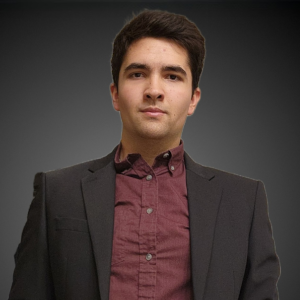
Hello, and welcome! My name is Bradley; I'm a Quad Fellow and recent Ph.D. graduate in mathematics at Texas Tech University supervised by Dr. Travis Thompson. My research interests focus on Applied Algebraic Topology, Homotopy Theory, and Topological Data Analysis. I am currently interested in problems at the intersection of Applied Algebraic Topology and biological processes on complex networks as well as neuropathologies such as Alzheimer's disease. Furthermore, I have a keen interest in machine learning, in particular, I am interested in the applications and theory of Geometric and Topological Deep Learning.
To learn more about my research, please refer to the research section. You can also download my CV below to learn more about me!
Getting on Your Nerves: A Restricted View of Intersections
SIAM TX-LA University of Texas at Austin, Austin, Texas invited
May, 2025
Syndemics: An Analysis of Factors Using Machine Learning Techniques
Quad Fellowship, Virtual invited
October, 2024
A Persistence Module is a Choice (Function)
SIAM TX-LA Baylor University, Waco, Texas invited
October, 2024
Understanding the Importance of Academic Outreach Across Societies and Cultures. Insights from a young scholar on networking with scientists, technologists, and politicians
Institute for Studies in Pragmaticism, Texas Tech University, Lubbock, Texas invited
March, 2024
Python: Visualization Methods and Topological Data Analysis
Institute for Studies in Pragmaticism, Texas Tech University, Lubbock, Texas invited
November, 2023
Networks, Topology, Data and Pathology
University of Louisiana at Lafayette, Lafayette, Louisiana invited
March, 2023
Dynamics, Dysfunction and Degeneration: The mathematics of Alzheimer's disease
The University of Texas at Austin, Austin, Texas accepted
Workskops
Date
Title
Where
September, 2025
Applied and Computational Topology and Geometry: New Developments
SIAM TX-LA University of Texas at Austin, Austin, Texas accepted
August, 2025
The Geometric Realization of AATRN
Institute for Math and Stat Innovation, Chicago, Illinois accepted
October, 2024
The Quad Summit
Institute of International Education, Washington, D.C invited
October, 2024
Advances in Algebra, Topology and Geometry with Applications to Data Analysis
Institute for Studies in Pragmaticism, Texas Tech University, Lubbock, Texas organized
March, 2024
Python: Part 1
Institute for Studies in Pragmaticism, Texas Tech University, Lubbock, Texas organized
November, 2023
Translational Mathematical Modeling and Data Science in Medicine
University of Louisiana at Lafayette, Lafayette, Louisiana organized
October, 2023
Topology and Geometry in Neuroscience
ICERM, Brown University, Providence, Rhode Island accepted
March, 2023
Groups and Dynamics Workshop
The University of Texas at Austin, Austin, Texas accepted
Playground
Mathematics is easier to feel than to read. Below are a few things you can touch — small canvases that respond to your mouse. The first row runs from vector calculus to topology; the finale is a hands-on Čech nerve, the construction at the heart of how we turn a point cloud into a shape. Drag points, slide radii, and watch the structure appear.
Interactive Math
Hover, drag, and slide. Every card is live.
Dot Product & Projection
Drag either arrow tip. The shadow is the projection of b onto a; the readout is the dot product.
Gradient Ascent & Descent
Move over the landscape. The arrow follows ±∇f — uphill fastest for ascent, downhill fastest for descent — always perpendicular to the level set.
The Moving Frame
A frame rides the curve: tangent T, normal N, and the osculating circle of radius 1/κ. Move the mouse to steer it; pick a curve above.
Riemann Sums
Vietoris–Rips & β0
Drag any disk — grab it anywhere, not just the center — or double-click to add one. An edge appears when two disks meet; a triangle fills when all three edges are present.
H0 & H1 Persistence Barcode
Drag any disk or double-click to add one. H0 bars track components merging; H1 bars track loops that are born when a cycle of edges closes and die when triangles fill it in. Choose the triangle rule (Rips or Čech) — it changes when loops die.
The Čech Nerve
Cover a point cloud with disks of radius r. The nerve of that cover records its combinatorics: one vertex per disk, an edge when two disks overlap, and a filled triangle exactly when three disks share a common point. The Nerve Theorem says this simplicial complex captures the true topology of the union of disks. Drag the points, sweep the radius, and read the structure below (computed up to dimension 2 — vertices, edges, and triangles).
Tip: double-click empty space to add a point, or drag a point onto another to remove it. The “Čech rule” fills a triangle only when the three disks truly share a point (min-enclosing-circle radius ≤ r); switch it off for the looser Vietoris–Rips flag rule.
Contact
The form below is under construction, so please either email me at Bradley.Z.Vigil@ttu.edu or send me a message on X (Twitter). I look forward to hearing from you!
This is bold and this is strong. This is italic and this is emphasized.
This is superscript text and this is subscript text.
This is underlined and this is code: for (;;) { ... }. Finally, this is a link.
Heading Level 2
Heading Level 3
Heading Level 4
Heading Level 5
Heading Level 6
Blockquote
Fringilla nisl. Donec accumsan interdum nisi, quis tincidunt felis sagittis eget tempus euismod. Vestibulum ante ipsum primis in faucibus vestibulum. Blandit adipiscing eu felis iaculis volutpat ac adipiscing accumsan faucibus. Vestibulum ante ipsum primis in faucibus lorem ipsum dolor sit amet nullam adipiscing eu felis.
Preformatted
i = 0;

while (!deck.isInOrder()) {
    print 'Iteration ' + i;
    deck.shuffle();
    i++;
}

print 'It took ' + i + ' iterations to sort the deck.';